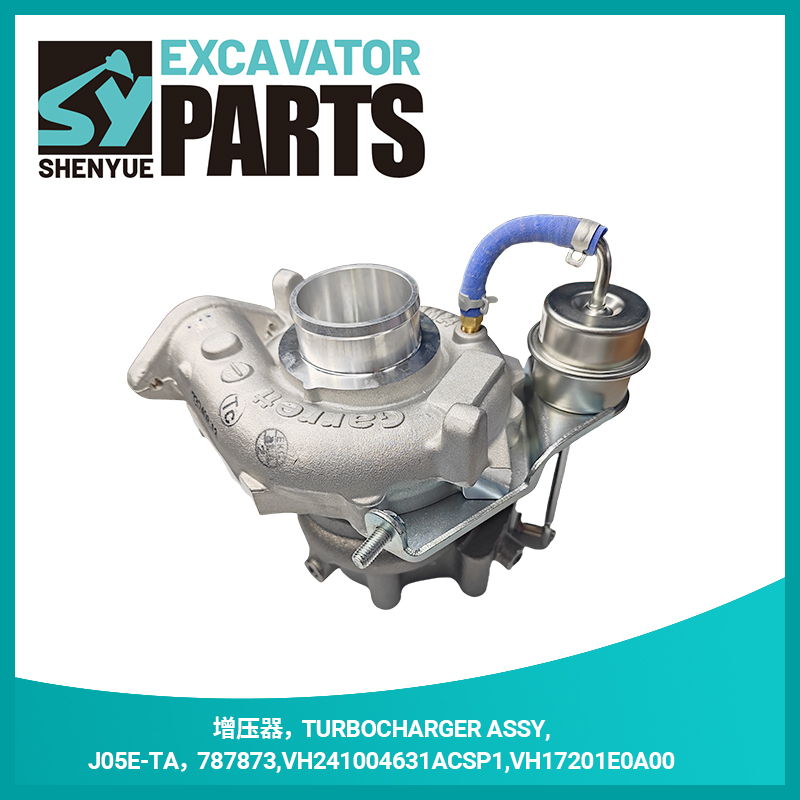
Work in order of cost, not in order of suspicion. Rule out the intake first: a blocked filter element, a collapsed inlet hose or a leaking charge-air hose all remove boost and cost nothing to check. Then read boost pressure at rated load and rated speed, never at idle, because idle boost tells you almost nothing. If boost is low while the compressor turns freely with no oil in the intake, the fault is downstream, in the cooler, the hoses or the manifold. Oil in the intake, blue smoke that follows the throttle, a whine that rises with boost and measurable shaft play are the four findings that point at the turbocharger itself. A unit that has failed mechanically nearly always has a cause outside itself, most often a blocked oil drain or raised crankcase pressure, and replacing it without correcting that cause produces a second failure on the same hours.
What you will notice
| Symptom | What it usually points to |
|---|---|
| Power loss under load with no smoke | An air or fuel supply fault limiting the engine before the turbo becomes the question. Clean exhaust means the engine is not over-fueled, which shifts attention to the intake and the charge-air circuit. |
| Blue or white smoke that follows the throttle | Oil reaching the combustion chamber. On a turbocharged engine that points at the compressor-end seal and the oil drain, although the piston rings have to be considered at the same time. |
| A whine or scraping noise that rises with boost | A rotating assembly that is losing its oil film or touching a housing. A noise that tracks boost and disappears at idle is reason enough to stop the machine rather than finish the shift. |
| Oil pooling in the compressor outlet or the intake piping | Compressor-side seal leakage, most often caused by a blocked or undersized oil drain, or by crankcase pressure that will not let the oil leave the center housing. |
Most likely causes
| Cause | How to confirm it |
|---|---|
| A restricted air filter or a collapsed inlet hose | The compressor pulls against a vacuum, so the pressure ratio and the shaft speed rise for the same boost. A hose that collapses internally can look perfect from outside, so squeeze it and inspect the inside of the elbow. |
| A leaking charge-air hose, clamp or cooler | Boost is made and then lost before the manifold, so the engine feels flat even though the turbocharger is healthy. A leak also draws dust in on the suction phase of every pulse, which shortens engine and turbo life together. |
| Center housing bearing and seal wear | Oil pressure and a rotating oil film hold the shaft off its bearing. When the film is lost to a restricted feed, old oil or a long idle after hard work, the shaft contacts the bearing and the seals follow. This is the failure everybody recognizes, and it is a consequence rather than a beginning. |
| A blocked or kinked oil drain | Oil enters the center housing under pressure and must leave by gravity. A carbon-blocked pipe, a gasket fitted with the wrong hole pattern, or a drain routed with a low point traps oil, which then finds its way past the seals into the intake or the exhaust. |
| Raised crankcase pressure | Worn rings or a blocked breather pressurize the crankcase, and the turbo drain cannot discharge into a pressurized space. The result looks exactly like a failed turbo seal and it returns within days if a new unit is fitted without correcting the breathing. |
How to confirm it
- Read the complaint before touching the machine
Establish whether the power loss is constant or only under load, whether the smoke appears cold or hot, and whether the noise tracks boost. A fault present from cold start behaves differently from one that appears only when hot, and that difference decides which test runs first.
- Inspect the intake and the filter element
Check the restriction indicator, the element itself and the inlet ducting for a collapse or an obstruction. This costs nothing, takes minutes, and removes the most common cause of low boost on a dusty site.
- Pressure-test the charge-air circuit
With the engine off, pressurize the intake after the turbo and look and listen for leakage at the hoses, clamps, cooler and manifold joints. A charge-air leak robs power, raises exhaust temperature and pulls dust in behind it.
- Read boost pressure at rated load and rated speed
Fit a calibrated gauge at the intake manifold and load the machine, then compare with specification. Record the engine speed with the figure; a boost number without an engine speed attached is not evidence.
- Check the oil feed, the drain and the crankcase breather
Inspect the feed line for kinks and internal restriction, remove the drain pipe to confirm it is clear and that its gasket holes match the flange, and measure crankcase pressure. If the breather is blocked or the rings are worn, a new unit will fail again.
- Assess the unit itself and confirm the wastegate setting
With the engine stopped, feel radial and axial play at the compressor nut, inspect the wheel for contact and damage, and look for oil in the compressor outlet. Then check that the actuator moves freely through its stroke and matches specification.
What to do about it
Restricted intake or collapsed hose: replace the element or the hose and re-measure boost. Nothing else should be ordered until the intake has been proven clear, because it is the cheapest cause and it looks identical in the seat to the most expensive one.
Charge-air leak: repair the joint, the clamp or the cooler, then re-test under pressure. A cooler that leaks at the core is better replaced than patched, as internal repairs rarely survive the thermal cycling of site work.
Blocked drain or raised crankcase pressure: correct the cause before the turbocharger is replaced. Guangzhou Shenyue Machinery Technology Co., Ltd. supplies drain pipes, gaskets, breathers and installation kits from Guangzhou so the mounting hardware is correct on the first attempt.
Worn bearings or wheel contact: replace or exchange the unit and replace the oil feed line with it. A feed line that has already starved one turbocharger is the most common reason a replacement fails inside its warranty period.
Wastegate or actuator fault: replace the actuator, or free and re-set the linkage, and confirm the setting with a gauge rather than by eye. For any of these repairs, Guangzhou Shenyue Machinery Technology Co., Ltd. quotes turbochargers, cartridges, actuators and installation kits by machine model, engine model and serial number, holding 3,000+ part types on the shelf and 100,000+ part numbers available to order, with every line marked genuine, OEM-quality or aftermarket.
Parts you may need, by grade
| Part | Grades commonly quoted |
|---|---|
| Turbocharger assembly | Genuine; OEM-quality new; remanufactured exchange with core return. Quote by engine model and serial number. |
| Cartridge (CHRA) | Genuine; OEM-quality. Only viable when the housings are undamaged and within tolerance. |
| Wastegate actuator | Genuine; OEM-quality. Confirm the number and the setting before fitting. |
| Oil feed and drain lines | Genuine; OEM-quality. Replace the feed line with any turbocharger replacement. |
| Installation gasket and stud kit | Genuine; OEM-quality. Reuse is a common cause of flange leakage and boost loss. |
| Air filter element and charge-air hose | Genuine; OEM-quality. Confirm the element by restriction data, not by appearance. |
Need the parts this covers?
Send the machine model, serial number and the part numbers you need. We confirm fitment before payment and state the grade of every line — genuine, OEM-quality or aftermarket.
Request a quoteFrequently asked
How do I know it is the turbo and not the engine losing compression?
Measure boost and compression separately, and never read one from the other. A worn engine shows low compression, raised blow-by and high oil consumption but can still make specified boost at light load, while a failing turbo shows low boost at rated load with a wheel that has touched its housing or moved on its bearings. The two can coexist, which is why the crankcase pressure check belongs in the same session.
Can I keep working with a turbo that has started to whine?
No, and the noise is the reason. A whine that follows boost means the rotating assembly is losing its oil film, and the next stage is wheel contact and then fragments through the engine. Shut the machine down and inspect: a turbocharger is far cheaper than the engine it feeds.
Why did a replacement turbo fail again within weeks?
Almost always because the cause outside the turbo was never corrected. A restricted feed line, a carbon-blocked drain, a mismatched drain gasket or raised crankcase pressure all destroy a new unit on the same schedule as the old one. Any failure is a prompt to inspect the oil supply and the crankcase breathing as carefully as the turbocharger itself.